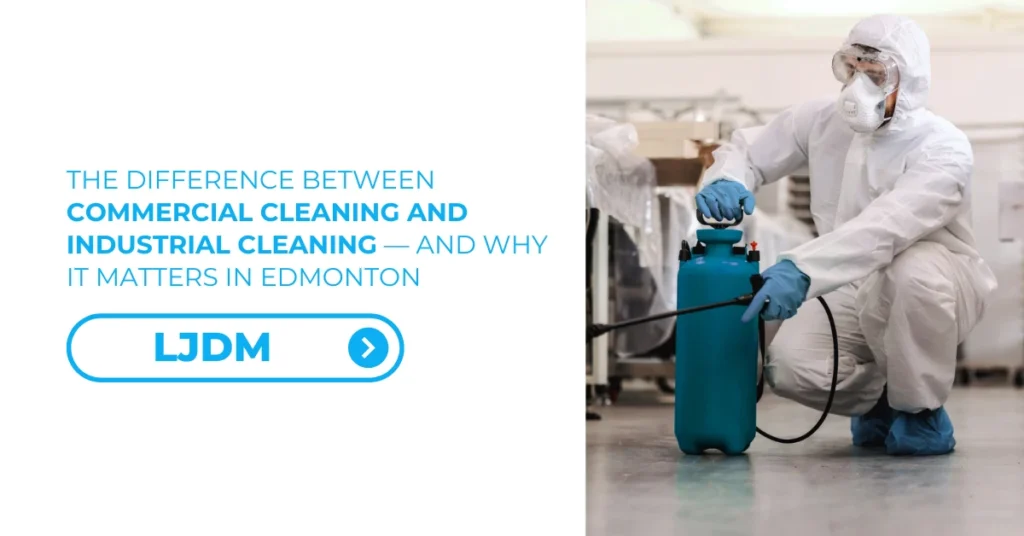
Every industrial facility manager has encountered this scenario: a commercial cleaning company is engaged for the facility’s cleaning needs, and within weeks the problems begin to compound. Cleaning staff are unfamiliar with the chemical hazards present on-site. Equipment appropriate for office environments is inadequate for the contamination loads present in a production or processing environment. Work areas that require coordinated cleaning during scheduled shutdowns are either missed or cleaned so insufficiently that the accumulated contamination resumes its impact on operations immediately. The reason for these failures is not a question of effort — it is a question of fundamental fitness for purpose. Industrial cleaning is a distinct discipline, and it demands a cleaning partner who is built for it.
What Makes Industrial Cleaning Categorically Different
The gap between commercial and industrial cleaning is not one of scale alone — it is one of kind. Several fundamental factors make industrial environments incompatible with standard commercial cleaning approaches:
Hazardous Material Exposure: Industrial facilities routinely involve chemical solvents, lubricants, coolants, heavy metals, combustible materials, and biological agents that require specific handling knowledge, PPE protocols, and disposal procedures. A cleaning technician without proper hazardous materials training is a liability in these environments — both for themselves and for the facility’s regulatory compliance standing.
Physical Scale and Access Challenges: Industrial cleaning regularly involves working at height, in confined spaces, within active machinery zones, or in areas accessible only during scheduled operational shutdowns. These access conditions require not only the appropriate equipment but the safety training and certifications to operate within them legally and without incident.
Contamination Complexity: The contamination profiles in industrial settings — heavy oil deposits, metal shavings, chemical residue, accumulated process dust, biological matter in food processing — require industrial-grade chemistry, specialized extraction equipment, and application methods that simply do not exist in a standard commercial cleaning program.
Operational Integration: Industrial cleaning does not happen around operations — it happens within them. Effective industrial cleaning requires coordination with production scheduling, maintenance shutdowns, and safety protocols that demand a cleaning partner who understands industrial operational rhythms, not just cleaning procedures.
The Regulatory Dimension: Alberta OHS and Industrial Cleaning Compliance
In Alberta, Occupational Health and Safety legislation establishes specific requirements for work performed in industrial environments, including cleaning activities. These requirements cover hazard identification and control, worker training and competency, PPE specifications, confined space entry protocols, and working-at-height procedures.
A cleaning company operating in an industrial facility without full compliance with these requirements creates regulatory exposure for both the service provider and the facility owner. In the event of a workplace incident, inadequate training or protocol documentation can shift significant liability toward the facility operator who engaged the non-compliant service.
LJDM’s industrial cleaning operations are structured from the ground up for Alberta OHS compliance. Our technicians receive industry-specific safety training, site-specific hazard orientation, and operate under documented safe work procedures that protect both our teams and our clients’ regulatory standing.
Common Industrial Cleaning Challenges LJDM Resolves
Heavy Oil and Lubricant Accumulation: Machinery zones in manufacturing and production facilities accumulate heavy hydrocarbon deposits that represent both fire hazards and equipment performance threats. Industrial degreasers applied with the correct method and extraction equipment remove these accumulations from floors, equipment exteriors, drainage systems, and structural elements — restoring both safety and efficiency.
Process Dust and Combustible Particulate: Sawdust, grain dust, metal powder, and other process-generated particulates are combustible when accumulated in sufficient concentrations. LJDM’s high-dust industrial cleaning protocols address these accumulations systematically, using HEPA-filtered vacuuming, wet suppression where indicated, and documented disposal — bringing facilities into compliance with fire safety and industrial hygiene standards.
Post-Maintenance and Shutdown Cleaning: Scheduled maintenance shutdowns create concentrated windows for deep cleaning that must be executed efficiently to minimize production downtime. LJDM coordinates with facility maintenance teams to deploy the right resources at the right time, maximizing cleaning completeness within the available shutdown window.
Chemical Spill Remediation: Unplanned spill events require immediate, trained response to prevent product loss, equipment damage, environmental release, and personnel exposure. LJDM’s industrial teams are equipped and trained for chemical spill containment and cleanup across a wide range of industrial chemical profiles.
Food Processing Facility Sanitation: Alberta’s food processing sector faces some of the most demanding sanitation standards of any industrial environment — combining the chemical complexity of industrial cleaning with the microbial control requirements of food safety regulation. Our food-safe sanitation protocols meet Canadian Food Inspection Agency (CFIA) standards, addressing everything from production line sanitation to drain cleaning and cold storage decontamination.
Why Scheduled Industrial Cleaning Programs Outperform Reactive Approaches
The natural tendency in industrial environments is to clean when contamination becomes visible or begins to affect operations. This reactive approach is consistently more expensive than a proactive, scheduled program — both directly and through its hidden costs.
Accumulated contamination is harder to remove than fresh contamination, requiring more chemical, more labour, and more time. Equipment degraded by contamination buildup requires more frequent maintenance and earlier replacement. Fire and safety hazards that develop gradually in the absence of scheduled cleaning create incident risks that dwarf any cleaning cost savings. And shutdown cleaning events that must remediate months of accumulated contamination take longer and cost more than regular, shorter cleaning interventions would have.
LJDM designs industrial cleaning programs that integrate with each facility’s production schedule, calibrate cleaning frequency to actual contamination rates rather than arbitrary intervals, and document everything — giving facility managers the oversight data they need to continuously optimize the program.
Edmonton’s Industrial Sector Deserves a Cleaning Partner That Matches Its Standards
Edmonton’s industrial economy — encompassing petrochemical processing, manufacturing, logistics, food production, and construction — operates at a scale and complexity that demands cleaning services built for those realities. LJDM’s industrial cleaning program is that answer: trained technicians, purpose-built equipment, documented safety protocols, and the operational flexibility to work within the demanding rhythms of Alberta’s industrial sector.
Contact our team at office@ljdm.ca or 780-782-0502 to discuss an industrial cleaning program designed for the specific demands of your facility.