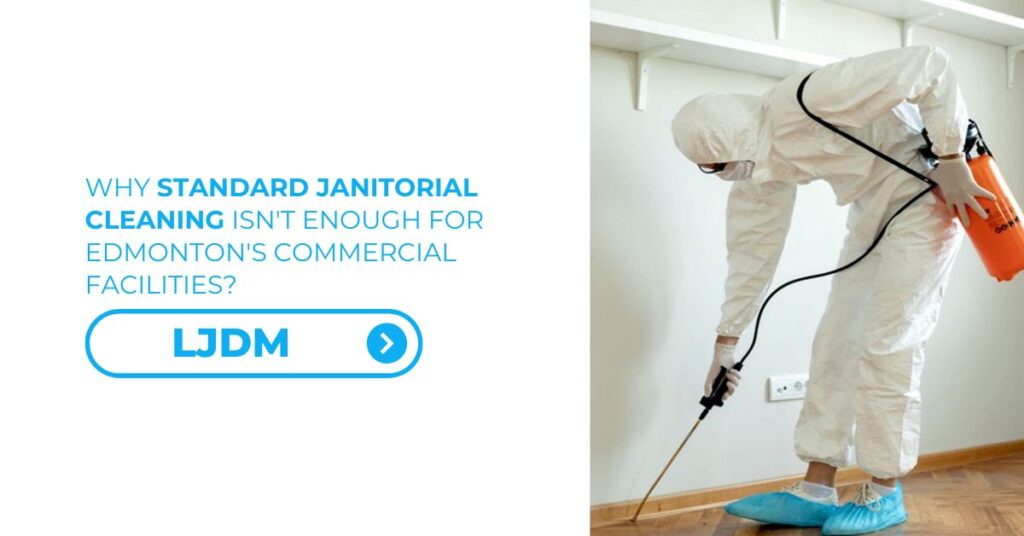
There is a persistent and costly misconception shared by many facility managers across Alberta: that routine janitorial cleaning and pathogen control are the same thing. They are not. Standard cleaning removes visible soil and maintains surface appearance. Pathogen control is a clinically structured process that systematically reduces the microbial load on surfaces, in the air, and throughout high-contact touchpoints—reducing the risk of illness transmission, protecting occupants, and ensuring regulatory compliance. For commercial facilities in Edmonton serving staff, clients, or the public, the distinction is not semantic. It is the difference between a building that looks clean and one that genuinely is.
Understanding the Gap Between “Clean” and “Decontaminated”
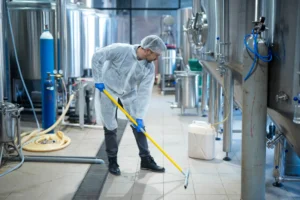
A surface can be visually spotless and still harbor thousands of viable pathogens per square centimetre. Viruses, bacteria, and fungi do not announce their presence. Standard cleaning products applied with standard protocols may reduce surface contamination by 40–60%—insufficient in environments where immunocompromised individuals, large numbers of people, or sensitive populations are present.
True pathogen control employs EPA-registered disinfectants with proven efficacy against specific threat organisms, applied correctly—meaning adequate dwell time is allowed for the chemistry to work, surfaces are pre-cleaned before disinfection, and products are matched to surface material to avoid degradation or chemical resistance buildup. Without these protocols, cleaning theater replaces cleaning science.
The High-Risk Environments in Edmonton’s Commercial Landscape
Pathogen control is not exclusively a healthcare concern. Several sectors face outsized risk from inadequate decontamination:
- Office Buildings: Shared keyboards, phones, elevator buttons, boardroom surfaces, and kitchen areas are among the highest-contact touchpoints in any facility. Research shows that viruses placed on a single office surface can spread to the majority of occupants within hours through contact transmission alone.
- Event Centers and Recreation Facilities: High-volume, transient populations from diverse geographic origins create concentrated exposure risks. A single post-event pathogen control protocol can determine whether the next event’s attendees enter a decontaminated or contaminated space.
- Educational Facilities: Schools and post-secondary campuses house populations uniquely susceptible to illness clustering. Without a structured pathogen control program, a single outbreak can rapidly spread through an entire student body, triggering absenteeism and reputational concerns.
- Banks and Financial Institutions: Teller counters, ATM interfaces, waiting areas, and safety deposit rooms represent dense collections of high-touch surfaces accessed by hundreds of individuals daily.
Government Buildings: Serving vulnerable and elderly populations alongside the general public, government facilities carry a heightened duty of care that standard janitorial services cannot meet alone.
The Science Behind Effective Pathogen Control
At LJDM, our pathogen control services are built on a framework of evidence, not assumption. Our approach incorporates:
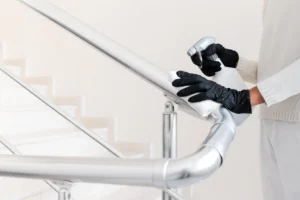
Surface Classification by Risk Level: Not all surfaces warrant equal attention. We identify and prioritize high-touch points — door handles, light switches, faucet hardware, handrails, shared electronics, restroom surfaces — where pathogen transfer risk is highest and cleaning frequency must be accordingly intensive.
Validated Disinfectant Chemistry: We use EPA List N-registered disinfectants with documented efficacy against the full spectrum of bacterial, viral, and fungal threats relevant to your specific facility type. Product selection is not generic — it is matched to the pathogen profile of your environment and the material compatibility of your surfaces.
Proper Dwell Time Protocols: This is one of the most commonly violated steps in commercial cleaning. A disinfectant that is wiped away in seconds after application has not fulfilled its contact kill time requirement. Our technicians are trained and held accountable to the contact times specified on product labels — because that is where the science lives.
HEPA Air Filtration and Fogging Where Indicated: For environments requiring a higher level of airborne pathogen control — such as healthcare settings or post-outbreak remediation — we deploy electrostatic spraying and HEPA air scrubbing technologies that reach surfaces and spaces inaccessible to manual cleaning alone.
Documented Verification: Our programs include log documentation that provides facility managers with a clear record of every treatment performed — essential for insurance compliance, health authority inspections, and internal accountability.
Pathogen Control as a Business Continuity Tool
The business case for structured pathogen control extends far beyond occupant health, though that alone is compelling enough. Consider the operational cost of a preventable illness outbreak: widespread absenteeism, potential temporary closure, regulatory scrutiny, reputational damage, and the hard cost of emergency deep cleaning. Each of these outcomes is dramatically more expensive than a proactive, scheduled pathogen control program delivered by professionals.
In an era where occupants — whether employees, clients, students, or patients — have heightened awareness of and expectations around hygiene standards, visible commitment to pathogen control is also a competitive differentiator. A facility that can demonstrate a documented, professional-grade pathogen control program signals a level of care and responsibility that builds trust and retention.
LJDM’s Pathogen Control Program: Structured, Scalable, and Edmonton-Ready
Whether you manage a 2,000 sq. ft. professional office or a 200,000 sq. ft. industrial complex, LJDM designs pathogen control programs scaled to your facility’s size, occupancy, and risk profile. We work around your operational schedule to minimize disruption, and our teams are trained in full PPE protocols to ensure their safety and yours throughout the process.
If your current cleaning program cannot answer the question “how do you verify surface pathogen reduction?” — it is time for a different conversation.
Contact LJDM at office@ljdm.ca or 780-782-0502 to schedule a facility assessment and learn what a professional pathogen control program looks like for your specific environment.